You have an idea for a novel/nonfiction book/stage play/screenplay/book of poetry/book of essays/etc. but you haven’t been able to actually do anything with it.
It sits there. An idea. Going nowhere.
If you don’t activate it soon, you’ll lose interest in it and enthusiasm about it.
You may have any number of excuses for not moving forward and developing your idea. Some of the most common excuses are:
I don’t have time to write.
I don’t know how to write or, I don’t know how to do this kind of writing.
I’m not good with spelling and grammar.
Other people whose works I’ve read are really good writers. Where do I get the nerve to even think that I can write in their space?
This will take me such a long time. Is it even worth it to start?
What if I finish it and it doesn’t get published?
What if it turns out to be awful? I’d be so embarrassed.
What if it gets published or I self-publish it and no one reads it?
Most of these excuses are bullshit, and badass writers don’t indulge in bullshit. Acknowledge them for what they really are: AN EXPRESSION OF FEAR.
I don’t have time to write. There are ways to squeeze writing time into the busiest schedule. I’ll recommend some in another post. But this is probably about you being afraid. If you write TEN MINUTES A DAY, you’ll put it more than an hour a week. You can accomplish a lot in an hour.
I don’t know how to write or, I don’t know how to do this kind of writing. You learn. You learn by doing and by reading about writing. There are MANY resources available to you (including some I offer).
I’m not good with spelling and grammar. Then you write what you want to write and either hire an editor/proofreader or get that smart English major friend of yours to correct your masterpiece for a few beers.
I’ve read books like the one I want to write by really good writers. Where do I get the nerve to even think that I can write in their space? These writers inspired you to write! And keep in mind the fact that they didn’t start out being really good writers. They probably started out feeling just as doubtful about their ability as you do now – BUT THEY DID START.
This will take me such a long time. Is it even worth it to start? That’s something you need to decide. However, wasting time thinking this way will not get you to the finish line any faster.
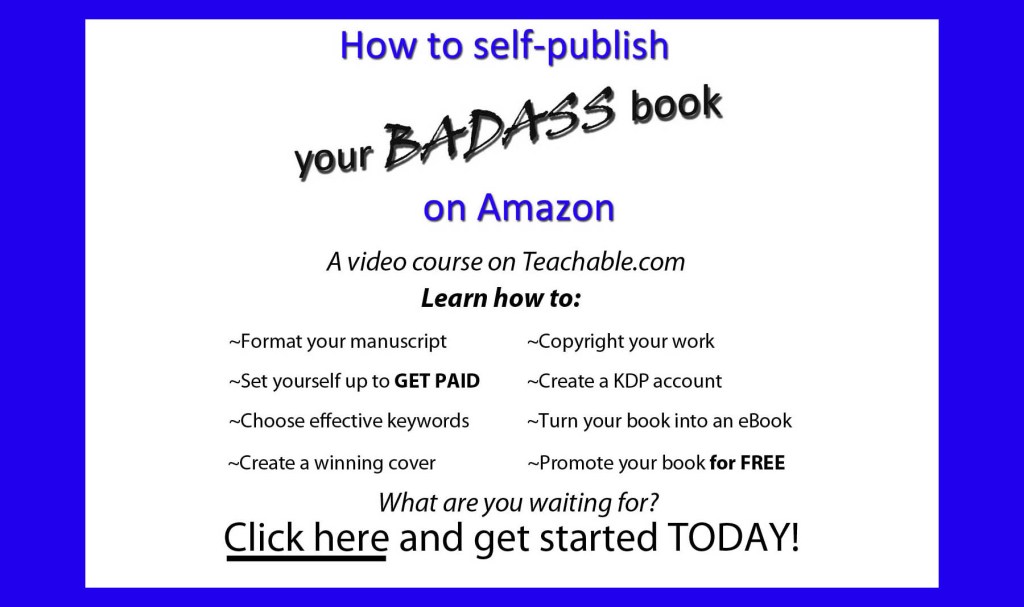
What if I finish it and it doesn’t get accepted by a publisher? Then you self-publish it. (SHAMELESS SELF-PROMOTION ALERT: See my course, How to Self-Publish Your Badass Book on Amazon. It’s on Teachable.com.)
What if I self-publish it and no one reads it? You will have to promote the hell out of it. I cover how to do that in the above-mentioned course.
What if it turns out to be awful? I’d be so embarrassed. There is no limit on the number of times you can revise it. You can continue to improve that. You can hire a co-writer or an editor to help you improve it.
There. There is no excuse for the excuses you’re using to excuse yourself from writing what you want to write.
Let’s start out with the usual disclaimer: this blog post is not intended to dispense professional mental health care advice, blah blah blah. If you need mental health care, go to a mental health care professional. That should be obvious. If you require serious help, there’s a therapist out there who’s waiting for your call.
However…I think it’s (legally) safe to say that many therapists advise their patients to keep journals as part of their treatment. There is widespread recognition that writing down your thoughts and feelings can help you cope with stress and anxiety, confront past trauma and process various emotions, good and bad.
In other words, writing has therapeutic value. And all this time, you thought writing was just a frustrating, crazy-making process!
If you keep a journal, could you – should you – use the deeply private thoughts in it as fodder for your creative writing? Should you lay bare the most private events of your life? Will it expose you to emotional harm? If there are others who appear in your journal entries, will they recognize themselves and be angry or upset with you, even if you change names and descriptions to conceal their identities?
In other words: will the creepy uncle who molested you when you were a child come after you with angry recriminations, or even a lawsuit, if you write about him and about what he did to you?
Fuck the creepy uncle.
Badass writers own their lives. Badass writers own the events that shaped them; the things that happened to them and they things they themselves did. Right or wrong, good or bad, the incidents, people and feelings that have made you who you are will also help make you the writer you want to be.
A play I wrote, “The Bucket List of Booze Club,” had a character in it, Amy, who was caregiver for her mother, who had Alzheimer’s. I drew on my own experiences for Amy’s dialogue. Whenever I worked on her monologues, I wept. Seriously. I cried buckets. That was because I was keeping it real.
Here is one of Amy’s monologues:
I got her one of those shower chairs so she can sit down once she’s in there, but getting her to step into the bathtub is hard. She’s scared. Afraid of falling. I have to hold onto her. She’s not heavy. In fact, she’s getting lighter and lighter, as if she’s just going to float away some day. When I’m bathing her…I can’t stand seeing her scared like that. And I try to reassure her, but I think she’s not just scared of falling. I can’t tell her not to be afraid of dying because it’s coming for her. I hope her mind is too far gone to understand that. And in the shower, she keeps thanking me again and again. She probably senses, somewhere in her mind, that her hygiene is…not good. She would have been horrified to know that she smells. And the adult diapers…
I’m not going to tell you that using your own painful experiences in your writing is easy. It’s not. Did I mention that I cried when I wrote parts of this play? And I’m not a big cryer.
It can be cathartic. It can help you work through things in a way that also helps other people. I’ve had so many audience members tell me that what Amy went through resonated with them. That somehow, seeing a hard part of their own lives play out in front of them, on a stage, was beneficial. It made them understand that they hadn’t been alone in what they’d gone through. During Amy’s most difficult scenes, there was an almost palpable feeling of recognition rippling through audiences. I am not the only person who’s ever been a caregiver for a parent with Alzheimer’s.
Whatever has happened to you- whatever you’ve been through- others have experienced it to. What you write can resonate with them, if you write well. If you write with honesty. It may not have a therapeutic effect for them (or for you, for that matter), but there is value in making people feel seen and heard, and that is what writing about your difficult experiences can achieve.
This is going to be a hard truth to swallow, so brace yourself. Even though you’ve written something you’re convinced is a one-of-a-kind piece – and it may well be – that’s not the way you want to sell it to literary agents and publishers.
The literary industry is, first and foremost, an industry. It exists to make money. Sure, it does so by managing the work of authors, which is pretty great. But it is, essentially, a profit machine.
Profit machines are not designed to take risks. On one level, agents and publishers are looking for the next fresh voice. They love books! They love reading and they love authors and they are always on the hunt for writing that speaks to them in some new way.
However, they must be reassured that there is some precedent for whatever it is you’re submitting to them – especially a precedent that sold well.
Name Dropping is Not Only OK…
When composing your query letter, you’ll make a stronger case for yourself if you place your book into a recognizable context. For example: “My thriller, Miles to Go Before I Die, explores territory familiar to readers of David Baldacci and Harlan Coben, but with a surprising main character: a flight attendant with a gambling addiction who finds herself thrown into a world of global intrigue.”
Damn. That sounds good. Maybe I should write that book! But note what I did in that description. I invoked the names of two best-selling authors, thereby associating myself with them and hinting that my writing is as good as theirs. Hinting. Then I drop a twist into it, by telling them about my main character. A flight attendant with a gambling addiction? If nothing else, it should make them curious.
The book does not have to be just like those written by Baldacci and Coben. The phrase “explores territory familiar to” is sufficiently vague.
What I’ve done here is to let the agent or publisher know that there is an existing readership for my book. Baldacci, Coben and other successful authors of thrillers have laid the groundwork for it and built up a community of readers who love thrillers. In other words, I am telling the publishing industry that my book is likely to make money. Is that guaranteed? Of course not – but the people I’m querying already know that. What they want to know is that profit is likely.
(Note: I’ve used a fiction example here, but this strategy can be used with nonfiction as well.)
Send a Signal
In the example above, I’m also demonstrating that I have some understanding of how the publishing industry works. I am sending a signal that the agent or publisher will not be dealing with some amateur who is trying to sell them a poorly written book.
The point of a query is to get agents and/or publishers interested enough to request your manuscript. They cannot afford to waste time and energy on a book that will probably not appeal to readers. Even if what you’ve written is unique, dropping names and mentioning genres will place your book in a recognizable – and intriguing context. It will increase your chances of having your manuscript read by decision-makers in the publishing industry.
Do download the checklist that you see below. Don’t necessarily answer the items in the order they’re in. Wha??? (you’re asking yourself) Why not??? (still you)
How to Use the Checklist
Instead of going down the checklist and deciding on details in an orderly fashion, DO IT THE BADASS WAY. Listen to your gut. Go with what you feel strongest about first. For instance, you may not arrive at a name for a character until you’ve figured out what he or she looks like, or eats for breakfast, or fears the most, or dreams about. And notice I used the phrase, “arrive at.” When you are really in tune with your badass writing self, you won’t have to fight to come up with words. They will come to you. They will recognize the badass creative door that you’ve opened for them and make themselves available to you, without any struggle on your part.
Sounds New Age-y, doesn’t it? It’s not. Being a badass means that you will have the confidence as a writer (and a person, generally) to access your imagination. To acknowledge your instincts and let them play out, on the page. To give yourself permission to BE a writer.
You don’t have to supply every detail on this list, either. Write as many descriptives as it takes for your character to emerge as a tangible being – one that you can set in motion, strutting through your story, wreaking chaos or healing heartbreak, suffering misfortune or inflicting harm on others. If age, appearance and a name are enough to fully flesh out your characters, you’re done with the list! Early on, though, it may be helpful to you to complete it, as an exercise. You don’t have to use all of the characteristics you jot down here in your work. They can simply function as subtext – something beneath the surface that informs the writing you do.
Remember that characters change throughout stories. They’re supposed to, in fact: that change is called an arc. For that reason, avoid falling too much in love with the fictional people you create. That could lead to you being rigid and resisting changes when your characters and storylines are telling you that they are needed.
About Stage Plays
It should go without saying (but I’m going to say it anyway): in stage plays, only use physical descriptions that are absolutely essential to the action of the play. (Don’t specify that a character should be tall if their height is irrelevant.) Keep in mind: the audience is not going to be reading the descriptions. Directors and actors are, for casting and character development purposes.
You may include:
Gender, age, race and regional background IF those things are important, such as if a character has a New England accent (that’s where the regional background comes in).
Personality traits and mannerisms, if they are essential to our understanding of the character. “He is an easy-going man who is uncomfortable with conflict.” “She appears eager to please, but there is a barely suppressed rage just beneath the surface.” “Her movements convey impatience.”
About Using Real People as Inspiration
Do it! There is absolutely nothing wrong with basing your characters on people you know – as long as they’re interesting. However, to prevent hurt feelings, make sure you change names and a few essential details, so Uncle Rufus does NOT realize that the foul-mouthed, abusive alcoholic in your story was inspired by him. No sense getting Uncle Rufus on your bad side, or stirring up family drama.
Use yourself, too. What you’ll find, as you progress as a BADASS WRITER, is that even characters that are drawn from your real life – acquaintances, relatives, loved ones – will evolve into composites. In one play I wrote, “The Bucket List of Booze Club,” several of the characters had experiences that mirrored mine, but were also distinctly different from me. Amy, had an emotional a monologue about giving her mother, who had Alzheimer’s, showers, and how her mother seemed so vulnerable at those times, so afraid of falling. My mother had Alzheimer’s. I gave her showers, and tried to allay her fears about falling. However, Amy was also a talented baker who was trapped in a lifeless marriage – neither of which applied to me. Another character, Jen, complained about bad first dates with men she met online. Jen’s hilarious stories were drawn from my bad first dates I had with men I met online! (At least I got something out of them.)
In a novel I wrote, “Palm Tree Pipe Dreams,” the protagonist is a wanna-be screenwriter from the Midwest who is living in L.A. and working as a low echelon, much-abused admin for a successful talent agent. I was a wanna-be screenwriter from the Midwest living in L.A. and working as a low echelon, much-abused admin for a successful talent agent…who also appears in the novel. I changed his name, but kept his self-centered, smug, patronizing personality.
Interested in self-publishing your book on Amazon but have no idea how to do it? Scroll down.
What is their race? I’d love to say that race doesn’t matter, but it does. Usually. It is one of the first things we notice about someone, along with gender and age. Don’t be afraid to assign a specific race to a character, and it doesn’t have to be your race. (See my blog post on the worst writing advice ever.)
What is their gender? Or are they gender fluid, or nonbinary, or transitioning from one to the other, or…?
Describe their physical appearance and the way they present themselves. I added that latter part to keep this as broad as possible. The things you note here can be permanent or temporary, such as short, thin, loves colorful clothes, fat, appears uncertain, balding, voluptuous, has a limp, smiles incessantly, tall, energetic, soft-spoken, confident, weary, etc. Don’t limit yourself to the obvious. (Read my blog post on Badass Character Descriptions That Will Inspire You.)
Family background: Did the character grow up with a single mom, or in a two-parent household, or with two same-sex parents, or with parents of different races/cultures/religions so there were clashes? Were they raised by a grandparent, an only child, a twin, one of many siblings, a middle child, the baby of the family, the oldest one? Did the family moved around a lot, stay in the same house for decades, have lots of stability, have no stability because of…? (Mental illness, substance abuse, etc.) Did they grow up working class, middle class, poor, wealthy? Our childhoods have a profound effect on how we are as adults. Give some thought to the familiar circumstances that shaped your character’s character.
What are some major events in their lives that have affected them? There will be some overlap here with the family background section, and that’s ok. Did a parent die young? Did they adopt a child? Get molested as a child? Win the lottery? Lose the big game? Witness a murder? Get featured on a sports arena jumbotron with a person who was not their spouse? Spend time in prison? Spend time as a caregiver for a loved one? Win a nationwide singing competition? Were they in a car accident that changed the trajectory of their life? Did they do something heroic? Something cowardly?
Where is the character from? What country, or state or region; a big city, a suburb, a small town, a rural area, a remote village. Did they start out in one place and move to another at an impressionable age?
What are they passionate about (if anything)? Hobbies? Interests? Are there activities they’ve always wanted to try, but haven’t yet? Are there things that broke them? Are they passionate about nothing? If so, why? Did an early disappointment in life teach them that embracing things enthusiastically is risky?
What do they love? Who do they love? Why do they love?
What do they fear? What do they dream of?
Who do they admire? Who do they despise? Who do they feel close to?
What are their political or religious beliefs? Do those differ from those of the people in their lives – people who are close to them or who they work with or deal with? Are they contrarians, or do they go along with the crowd?
What do they hope to achieve in life? (Or have they already achieved it?)
What do they regard as their biggest failure? Their biggest success?
How would you describe a character’s relationships with the other characters in your story? Yeah, this gets complicated. Relationships, though, are the beating heart of fiction and drama, so give them plenty of attention. They can be simple, tangled, tortured, dysfunctional, bitter, loving or fractious. They will also change, or be revealed, during the tale you’re telling. Think about the relationships in your own life. The closer you are to someone, the likelier that your relationship with them has many layers, some healthy and supportive, some negative and frustrating.



 Write Like a Badass