You have an idea for a novel/nonfiction book/stage play/screenplay/book of poetry/book of essays/etc. but you haven’t been able to actually do anything with it.
It sits there. An idea. Going nowhere.
If you don’t activate it soon, you’ll lose interest in it and enthusiasm about it.
You may have any number of excuses for not moving forward and developing your idea. Some of the most common excuses are:
- I don’t have time to write.
- I don’t know how to write or, I don’t know how to do this kind of writing.
- I’m not good with spelling and grammar.
- Other people whose works I’ve read are really good writers. Where do I get the nerve to even think that I can write in their space?
- This will take me such a long time. Is it even worth it to start?
- What if I finish it and it doesn’t get published?
- What if it turns out to be awful? I’d be so embarrassed.
- What if it gets published or I self-publish it and no one reads it?
Most of these excuses are bullshit, and badass writers don’t indulge in bullshit. Acknowledge them for what they really are: AN EXPRESSION OF FEAR.

- I don’t have time to write. There are ways to squeeze writing time into the busiest schedule. I’ll recommend some in another post. But this is probably about you being afraid. If you write TEN MINUTES A DAY, you’ll put it more than an hour a week. You can accomplish a lot in an hour.
- I don’t know how to write or, I don’t know how to do this kind of writing. You learn. You learn by doing and by reading about writing. There are MANY resources available to you (including some I offer).
- I’m not good with spelling and grammar. Then you write what you want to write and either hire an editor/proofreader or get that smart English major friend of yours to correct your masterpiece for a few beers.
- I’ve read books like the one I want to write by really good writers. Where do I get the nerve to even think that I can write in their space? These writers inspired you to write! And keep in mind the fact that they didn’t start out being really good writers. They probably started out feeling just as doubtful about their ability as you do now – BUT THEY DID START.
- This will take me such a long time. Is it even worth it to start? That’s something you need to decide. However, wasting time thinking this way will not get you to the finish line any faster.
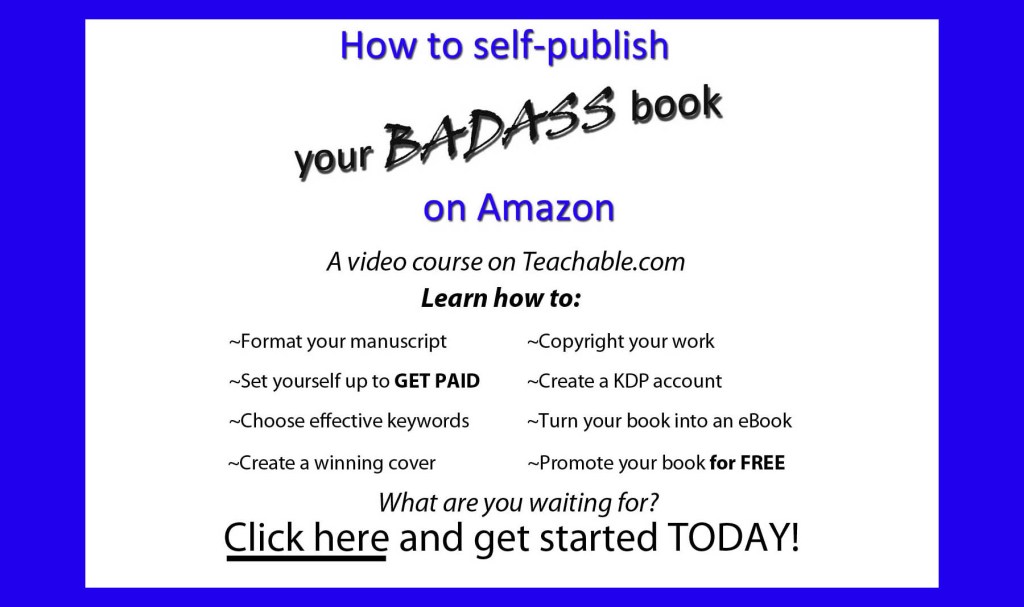
- What if I finish it and it doesn’t get accepted by a publisher? Then you self-publish it. (SHAMELESS SELF-PROMOTION ALERT: See my course, How to Self-Publish Your Badass Book on Amazon. It’s on Teachable.com.)
- What if I self-publish it and no one reads it? You will have to promote the hell out of it. I cover how to do that in the above-mentioned course.
- What if it turns out to be awful? I’d be so embarrassed. There is no limit on the number of times you can revise it. You can continue to improve that. You can hire a co-writer or an editor to help you improve it.
There. There is no excuse for the excuses you’re using to excuse yourself from writing what you want to write.
Get to it.


 Write Like a Badass