Overcoming Writing Excuses: Start Your Book Today

You may have any number of excuses for not moving forward and developing your idea. Some of the most common excuses are:

  1. I don’t have time to write.
  2. I don’t know how to write or, I don’t know how to do this kind of writing.
  3. I’m not good with spelling and grammar.
  4. Other people whose works I’ve read are really good writers. Where do I get the nerve to even think that I can write in their space?
  5. This will take me such a long time. Is it even worth it to start?
  6. What if I finish it and it doesn’t get published?
  7. What if it turns out to be awful? I’d be so embarrassed.
  8. What if it gets published or I self-publish it and no one reads it?

Most of these excuses are bullshit, and badass writers don’t indulge in bullshit. Acknowledge them for what they really are: AN EXPRESSION OF FEAR.

  1. I don’t know how to write or, I don’t know how to do this kind of writing. You learn. You learn by doing and by reading about writing. There are MANY resources available to you (including some I offer).
  2. I’m not good with spelling and grammar. Then you write what you want to write and either hire an editor/proofreader or get that smart English major friend of yours to correct your masterpiece for a few beers.
  3. I’ve read books like the one I want to write by really good writers. Where do I get the nerve to even think that I can write in their space? These writers inspired you to write! And keep in mind the fact that they didn’t start out being really good writers. They probably started out feeling just as doubtful about their ability as you do now – BUT THEY DID START.
  4. This will take me such a long time. Is it even worth it to start? That’s something you need to decide. However, wasting time thinking this way will not get you to the finish line any faster.
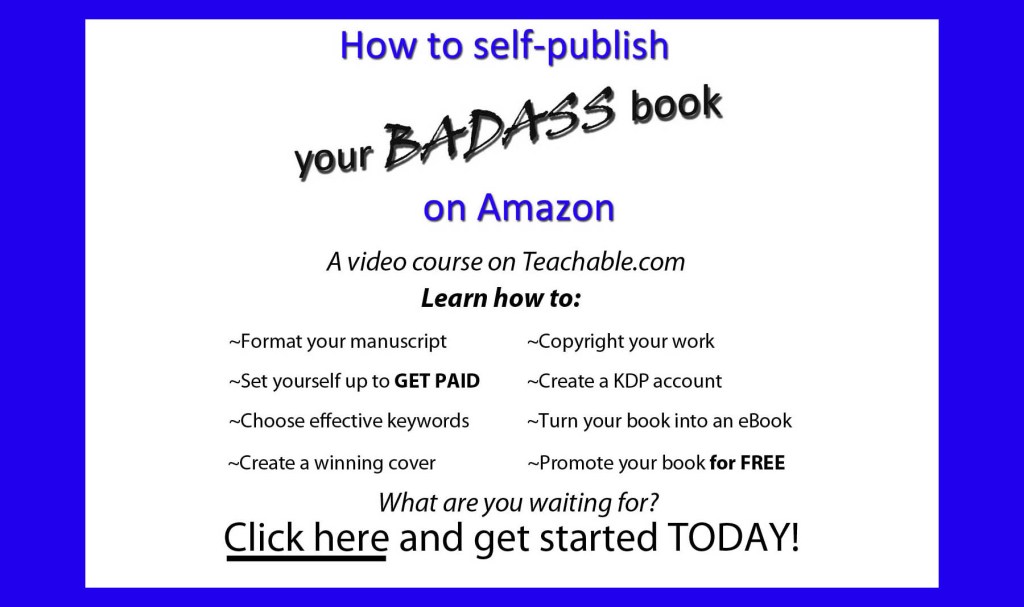
  5. What if I finish it and it doesn’t get accepted by a publisher? Then you self-publish it. (SHAMELESS SELF-PROMOTION ALERT: See my course, How to Self-Publish Your Badass Book on Amazon. It’s on Teachable.com.)
  6. What if I self-publish it and no one reads it? You will have to promote the hell out of it. I cover how to do that in the above-mentioned course.
  7. What if it turns out to be awful? I’d be so embarrassed. There is no limit on the number of times you can revise it. You can continue to improve that. You can hire a co-writer or an editor to help you improve it.

There. There is no excuse for the excuses you’re using to excuse yourself from writing what you want to write.

Get to it.
Writing Your Trauma

However…I think it’s (legally) safe to say that many therapists advise their patients to keep journals as part of their treatment. There is widespread recognition that writing down your thoughts and feelings can help you cope with stress and anxiety, confront past trauma and process various emotions, good and bad.

In other words, writing has therapeutic value. And all this time, you thought writing was just a frustrating, crazy-making process!

If you keep a journal, could you – should you – use the deeply private thoughts in it as fodder for your creative writing? Should you lay bare the most private events of your life? Will it expose you to emotional harm? If there are others who appear in your journal entries, will they recognize themselves and be angry or upset with you, even if you change names and descriptions to conceal their identities?

In other words: will the creepy uncle who molested you when you were a child come after you with angry recriminations, or even a lawsuit, if you write about him and about what he did to you?

Fuck the creepy uncle.

Badass writers own their lives. Badass writers own the events that shaped them; the things that happened to them and they things they themselves did. Right or wrong, good or bad, the incidents, people and feelings that have made you who you are will also help make you the writer you want to be.

A play I wrote, “The Bucket List of Booze Club,” had a character in it, Amy, who was caregiver for her mother, who had Alzheimer’s. I drew on my own experiences for Amy’s dialogue. Whenever I worked on her monologues, I wept. Seriously. I cried buckets. That was because I was keeping it real.

Here is one of Amy’s monologues:

I got her one of those shower chairs so she can sit down once she’s in there, but getting her to step into the bathtub is hard. She’s scared. Afraid of falling. I have to hold onto her. She’s not heavy. In fact, she’s getting lighter and lighter, as if she’s just going to float away some day. When I’m bathing her…I can’t stand seeing her scared like that. And I try to reassure her, but I think she’s not just scared of falling. I can’t tell her not to be afraid of dying because it’s coming for her. I hope her mind is too far gone to understand that. And in the shower, she keeps thanking me again and again. She probably senses, somewhere in her mind, that her hygiene is…not good. She would have been horrified to know that she smells. And the adult diapers…

I’m not going to tell you that using your own painful experiences in your writing is easy. It’s not. Did I mention that I cried when I wrote parts of this play? And I’m not a big cryer.

It can be cathartic. It can help you work through things in a way that also helps other people. I’ve had so many audience members tell me that what Amy went through resonated with them. That somehow, seeing a hard part of their own lives play out in front of them, on a stage, was beneficial. It made them understand that they hadn’t been alone in what they’d gone through. During Amy’s most difficult scenes, there was an almost palpable feeling of recognition rippling through audiences. I am not the only person who’s ever been a caregiver for a parent with Alzheimer’s.

Whatever has happened to you- whatever you’ve been through- others have experienced it to. What you write can resonate with them, if you write well. If you write with honesty. It may not have a therapeutic effect for them (or for you, for that matter), but there is value in making people feel seen and heard, and that is what writing about your difficult experiences can achieve.

Keeping Track of Submissions

The why is easy. You want to keep a record of the people, companies, theatres etc. that you have sent your work to – or sent a query letter to – so that you don’t:
• Duplicate submissions (which will waste your time and piss the submittees* off)
• Miss submitting to someone you should submit to (which may prevent you from getting published or produced)

I recommend using an Excel worksheet. It’s easy to use and does everything you need it to do. If you have another program that you prefer, use it. There is no one way to do this.

What should your spreadsheet include?

• The name of your work – this can either be a column, or you can have an entire tab devoted to one work.
• The name and title of the person or company or organization you’re submitting to.
• The name of the publishing company, theatre company, publication or whatever organization it is that you are sending to.
• What you’re sending. Is it a query letter? The first ten pages or three chapters? A synopsis? What goes in this column will depend upon what the submittee says he or she wants you to send. You can find this information on the company’s website. Do not ignore it. If a literary agent wants a synopsis and the first five pages, do NOT send the entire novel or nonfiction book because it is so brilliant, so well-written THAT YOU ARE CERTAIN the agent will want to read the entire thing, not just five pages. If the agent likes those pages, he or she will ask to see the entire manuscript. Disregarding instructions is a BIG red flag; you are letting the agent know that you will be difficult to work with. Likewise, if a publisher says they don’t accept unagented work and you don’t have an agent, don’t send to them out of an overabundance of confidence. It will be a wasted effort.

You may NEVER get a response

Sadly, many cells in this column will stay blank. You often won’t hear back from agents or publishers – even those who say they are open to submissions. Accept that fact right now, so you won’t pine away for an acknowledgement that you exist. That you write. Some agents will answer you, but that will almost always take a looooooong time. Agents get a lot of submissions. Don’t think about that. It will only depress and discourage you. If you are determined to be a writer, write and submit. Rinse and repeat. Screw the competition.

If you actually DO get a response-

Keep notes about them. I might write something like: “nice rejection email – it’s in agent folder.” That tells me to check that email I saved the next time I submit a (different) work to that agent. I might use the comments in their email, to remind them that they liked my writing the last time. “I appreciated the positive feedback and constructive criticism you gave me on my novel, ‘Palm Tree Pipe Dreams.’” With that, I am reminding the agent that even though they did not decide to represent me, there was something about my writing that they liked. If an agent absolutely HATED my work (and they will rarely admit to that), I jot that down, too, so that I don’t waste time sending to them in the future.

Other things to keep track of

Make note of things you learn that will save you time and effort going forward. Things like:
• Ms. QPOEIREWPOIU is no longer with this agency.
• This agency is no longer in business.
• This agency says it no longer accepts submissions.
Like that. Information that will help you going forward.
A lot of the above is relevant for fiction, nonfiction, short stories, plays and other creative endeavors. You can also keep a spreadsheet when applying for paid writing assignments or for full- or part-time writing jobs.